James Westwater
Artist
James Westwater
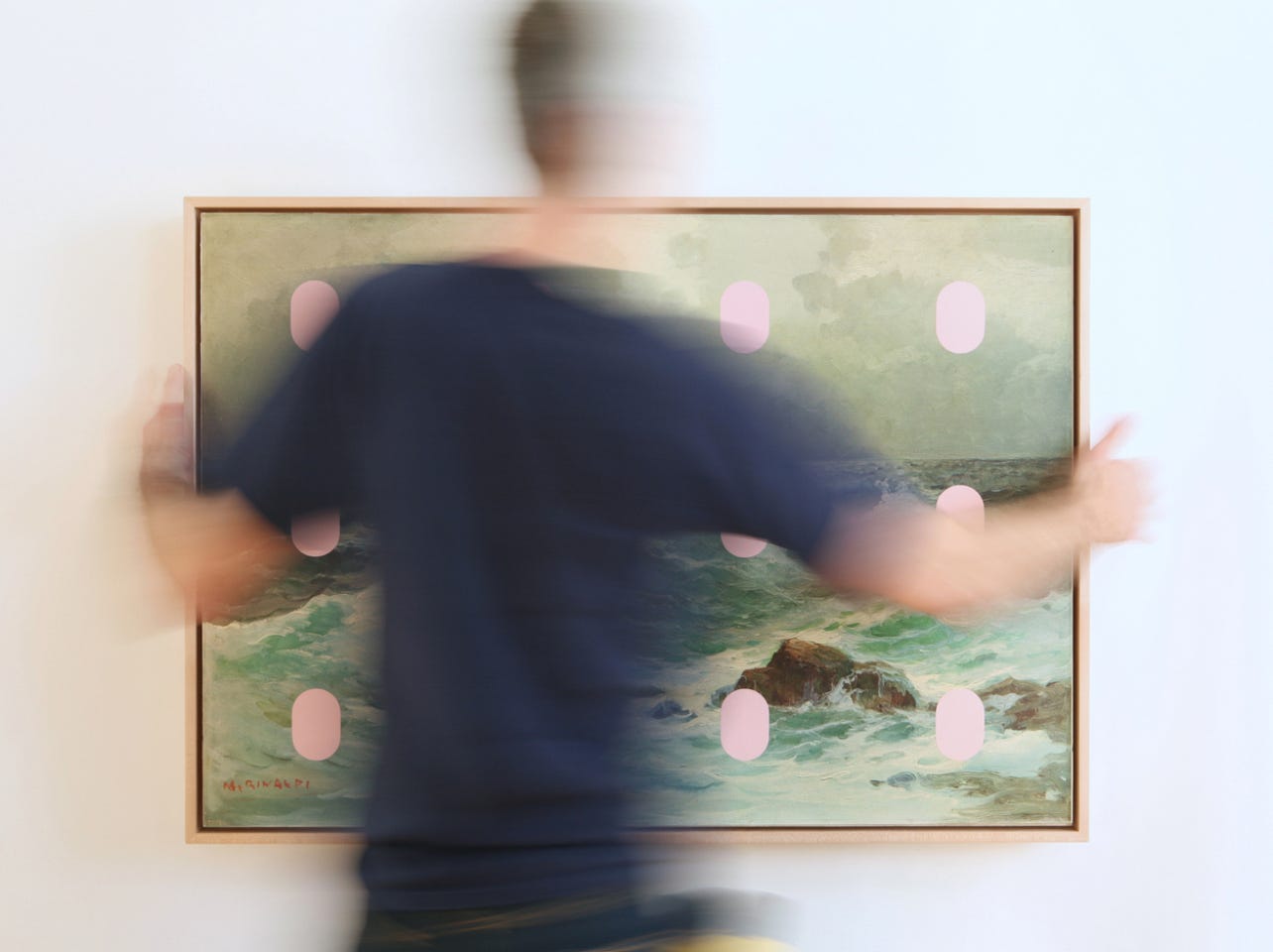
What makes something “art” isn't whether it took technical skill in the traditional sense. It’s whether the artist is making choices that create meaning, tension, emotion, commentary, or a new way of seeing something. That’s why someone like James Westwater can take vintage photographs and place curved rectangles over them and still be operating within the territory of art rather than pure prank or parody.
The key thing is intentionality. Those curved forms interrupt the original image. They obscure information, redirect your eye, flatten space, create mystery, and force you to notice composition in a way you otherwise wouldn’t. A vintage photo by itself often disappears into nostalgia. Once altered, you stop consuming it passively and start examining it. The shape becomes a visual disruption. It asks, “What are we choosing to see, and what are we ignoring?”
That may sound abstract, but modern art has worked this way for over a century. Marcel Duchamp famously put a urinal in a gallery in 1917 and called it art. Not because the urinal itself was beautiful, but because the gesture challenged assumptions about authorship, context, and taste.
Likewise, Mark Rothko painted giant blocks of color that many people initially dismissed as simplistic. Yet those paintings create mood, scale, and emotional immersion that can feel overwhelming in person.
The mistake people often make is assuming
Born in Brazil, James Westwater is a visual artist based in Washington, DC, after living, working, studying, and teaching worldwide. Throughout his many years as an artist, he has made an impressive and well-deserved name with his distinctive approach to form and line.
Known partially for incorporating the aforementioned straight-sided ovals into his work, Westwater’s art explores balance, tension, and harmony through minimalist shapes and clean, bold lines.
Westwater’s pieces evoke a sense of quiet precision, inviting viewers to reflect on the subtleties within the geometric forms he presents.
Married to Naomi Sachs, a brilliant landscape architect who shares his passion for thoughtful design, James Westwater’s art often feels like an ongoing conversation between the organic and the constructed, each piece a dialogue between nature and human intervention.
From the artist's website:
“James Westwater's painting series includes Ovals, Corners, Edges, and Drift. Influences include suprematism, hard-edge, and minimalism.”
My understanding of his work is, of course, deeply personal, shaped by my perspective and interpretation. It’s not the polished, definitive analysis you might find from a formal art critic but rather my subjective engagement with his art. In that sense, it’s as much a reflection of me (or any viewer) as it is of Westwater’s vision. In this interaction, meaning emerges through experience rather than an expert decree.
From where I sit, Westwater’s use of straight-sided ovals seems to be a defining element in his art. However, its significance extends beyond mere visual appeal. Not unlike Kandinsky's concepts, the ovals appear to symbolize the balance between structure and fluidity, stability and change, and order and chaos. They certainly aren’t “jokes about art” unless he just has me fooled.
Unlike perfect circles or completely angular forms, Westwater’s straight-sided ovals exist in a space between the organic and the geometric. This duality gives them a unique power, as they represent the tension and harmony inherent in both natural and human-made worlds.
One critical aspect of these ovals is their versatility as symbols. On one level, they can be seen as windows or portals, inviting viewers to look beyond the artwork's surface and contemplate more profound, abstract ideas.
By placing them in his compositions, Westwater creates a sense of depth and perspective, suggesting that each piece of art is more than what it appears. These ovals act as gateways into other realms, whether the artist’s inner world or broader reflections on society and nature.
To me, the ovals signify balance and transformation. Their straight edges imply rigidity and structure, while their curved portions suggest motion and fluidity. This blend of contrasts embodies Westwater’s exploration of the equilibrium between control and freedom.
Moving right along…James Westwater’s Plywood Chateaux pieces (below) represent a departure from his earlier paintings, showing how versatile and curious he is as an artist. Unlike his more structured, linear works, these chateaux are whimsical constructions made of humble plywood, a material you might associate more with unfinished furniture than fine art. Yet, somehow, Westwater transforms this everyday material into something profound.
The Plywood Chateaux series doesn’t immediately declare its purpose. They look like miniature versions of life, perhaps a commentary on the fragility of human ambition or just a clever juxtaposition of form and function. I tend to think they’re a bit of all three, with a dash of irony thrown in for good measure. After all, what better way to reflect on our desire for grandeur than by crafting delicate, detailed mansions out of something so basic and temporary? It’s as if Westwater is gently reminding us that even our loftiest creations can be, at their core, as superficial and fleeting as plywood.
The beauty of these pieces lies in their layers of meaning, much like the layers of plywood they’re constructed from. Some may see them as architectural models, others as social commentary, but to me, they invite a more intimate reflection—on the things we build, the materials we use, and the stories we tell ourselves about permanence and importance. There’s something wonderfully human about that, don’t you think? A little humor, a lot of thought, and just enough plywood to keep things grounded.
“James Westwater's installations include paintings, drawings, and found objects. The scale ranges from tabletop to walls to architectural spaces.”
Westwater’s versatility as an artist truly shines in his conceptual work, where the focus shifts from the physical form to the ideas driving the art. This aspect of his practice spans a wide range of mediums…text and performance pieces, altered objects, environments, and even land art, each chosen to communicate complex concepts rather than just aesthetic appeal. For Westwater, art isn't merely about what we see; it’s about what we think, question, and feel in response.
His text and performance pieces invite audiences to engage intellectually, often blurring the lines between art and lived experience. By incorporating language and action into his work, Westwater challenges viewers to consider the power of words and movement as vehicles for artistic expression, prompting reflection on the meaning we ascribe to everyday moments and objects.
The altered objects and environments he creates further exemplify this conceptual depth. Rather than crafting entirely new forms, Westwater repurposes familiar items, subtly shifting their context to evoke new meanings. This approach plays with our perceptions, asking us to reconsider what we think we know about the things we encounter daily. His land art, often using nature as both medium and message, explores humanity’s relationship with the environment, prompting questions about our role in shaping, and being shaped by, the natural world.
Through these varied mediums, Westwater’s conceptual art seems to emphasize the importance of thought and interpretation, reminding us that art is not just what we observe but how we engage with the ideas behind it.
Much like the rest of his work, his photography serves as a vehicle for more profound reflections on human interaction with natural and constructed environments.
This year, James Westwater had his first public exhibition in Washington, D.C. with a series of paintings shown at Manse
According to his website Westwater’s exhibited work explores new configurations for Corners, Ovals, and Edges as the artist returns to ornate and gilt frames for the first time since BlueBoy and Pinkie paintings of 2008.