The King’s Toe
Gout has gone decidedly downmarket

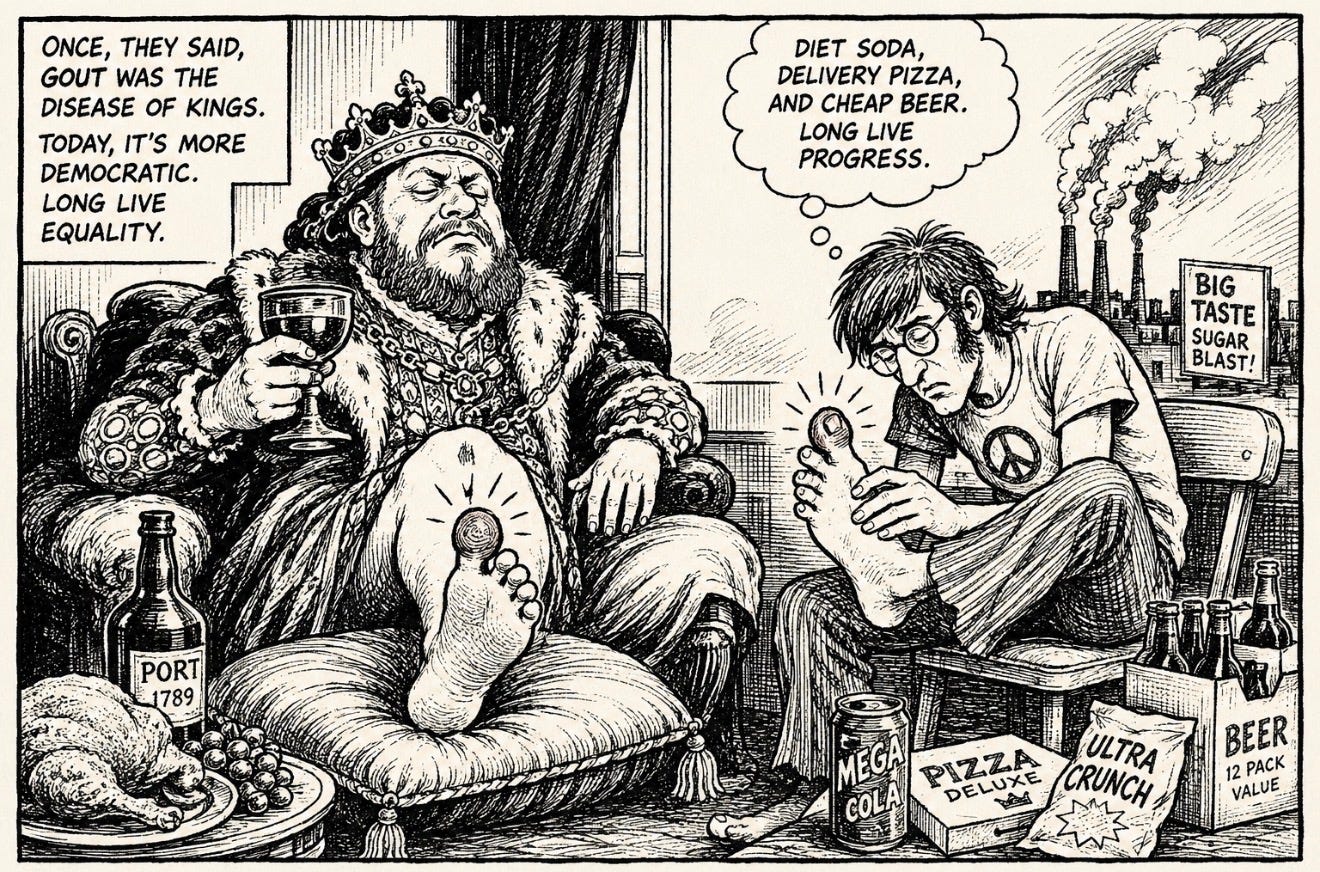
For centuries, gout had terrific public relations. If you were going to wake up at three in the morning feeling as though someone had driven a hot nail through your big toe, at least you could console yourself with the knowledge that Henry VIII might have understood.
Gout was called the “disease of kings” because it was associated with people wealthy enough to consume extravagant quantities of meat, seafood and alcohol. Portraits of prosperous gentlemen practically came with an inflamed foot. The poor had plenty of diseases, but gout carried a peculiar whiff of privilege.
That history makes the modern resurgence of gout especially interesting to me. The disease hasn’t disappeared. It has expanded its customer base.
About 55.8 million people worldwide were living with gout in 2020, according to a major Global Burden of Disease analysis published in 2024. Researchers project that number could reach nearly 96 million by 2050. Gout prevalence is increasing as populations age and rates of obesity and metabolic disease rise.
The old explanation that gout is simply the consequence of rich people behaving badly doesn’t survive much scrutiny anymore.
Gout develops when uric acid builds up in the blood and urate crystals collect in a joint. The resulting gout attack can produce spectacular pain, swelling and redness, often in the big toe. Diet can contribute, certainly. So can alcohol and sugary drinks. But kidney function, genetics, obesity, insulin resistance, diabetes, hypertension, heart failure and certain medications can also increase gout risk.
That matters because blaming somebody for gout is both medically lazy and socially revealing.
The demographics are revealing, too. American research has found gout prevalence of about 7 percent among Black men compared with 5.4 percent among white men. Among Black women, it was 3.5 percent compared with 2 percent among white women. Researchers have examined kidney disease, body mass, diet, poverty, alcohol use and medication as contributors to those disparities.
Women deserve particular mention because gout is still routinely imagined as an older man’s disease. Women do get gout, especially after menopause, when the protective effect of estrogen on uric acid levels declines. A woman with a violently painful swollen toe may not resemble our cultural picture of a gout patient, which is precisely why old stereotypes can become medically unhelpful.
What fascinates me most is the class reversal.
Foods and drinks once available mainly to the affluent became cheap, industrialized and everywhere. Sugar sweetened beverages don’t require a palace. Ultra processed food doesn’t require inherited wealth. At the same time, access to nutritious food, preventive medical care and effective long term treatment isn’t distributed equally.
So the disease of kings didn’t exactly abdicate.
It democratized.
There’s something darkly comic about humanity finally achieving equality by giving ordinary people access to an ailment once associated with aristocrats. We couldn’t redistribute the castles, apparently, but we did a magnificent job redistributing the uric acid.
I’d have preferred the castles.